PCOS Treatment in Chennai
Evidence-based management of Polycystic Ovary Syndrome — from restoring regular ovulation to achieving a healthy pregnancy, tailored to your specific PCOS type.

Polycystic Ovary Syndrome is the most common hormonal disorder affecting women of reproductive age, yet no two patients present the same way. Some women experience irregular periods and difficulty conceiving, while others may have regular cycles but struggle with weight gain, acne, or thinning hair. At our Chennai clinic, Dr. Rukkayal takes a phenotype-specific approach — identifying whether your PCOS is driven primarily by insulin resistance, hyperandrogenism, or anovulation — to design a treatment plan that addresses your unique physiology rather than applying a generic protocol.
Fertility-focused PCOS management requires more than prescribing ovulation-inducing medication. Dr. Rukkayal evaluates metabolic health, androgen levels, ovarian morphology, and endometrial receptivity as an integrated picture. For patients who need assisted reproduction, her direct IVF laboratory expertise is particularly valuable: women with PCOS often produce a high number of eggs during stimulation, and careful laboratory handling is essential to maximize embryo quality while minimizing the risk of ovarian hyperstimulation syndrome. Whether your goal is to conceive naturally, through IUI, or with IVF, the treatment plan is built around your diagnosis, your response to initial interventions, and your personal timeline. Lifestyle optimization — including dietary guidance and targeted exercise — is woven into every plan because metabolic improvement often enhances the effectiveness of medical treatment significantly.

1500+
PCOS Patients Managed
90%
Ovulation Restoration Rate
Symptoms That May Indicate PCOS
You should see a specialist if you experience:
- Irregular, infrequent, or absent menstrual periods
- Unexplained weight gain, especially around the midsection
- Persistent acne on the face, chest, or back
- Excess hair growth on the face, chin, or body (hirsutism)
- Difficulty conceiving despite regular intercourse
- Thinning hair or hair loss from the scalp
Understanding PCOS
Polycystic Ovary Syndrome (PCOS) is a complex hormonal condition that affects an estimated 8 to 13 percent of women of reproductive age worldwide, though many cases remain undiagnosed. The hallmark of PCOS is a disruption in the normal hormonal signalling that triggers ovulation each month. In a typical cycle, the pituitary gland releases follicle-stimulating hormone (FSH) to develop one dominant follicle, which then releases a mature egg. In PCOS, elevated levels of luteinizing hormone (LH) and androgens (such as testosterone) interfere with this process, causing multiple small follicles to develop without any single one reaching maturity — hence the characteristic "polycystic" appearance on ultrasound. PCOS presents in several distinct ways. Classic PCOS involves irregular periods, elevated androgens, and polycystic ovaries. Some women have lean PCOS with a normal body weight but still experience anovulation and hormonal imbalance. Others have insulin-resistant PCOS where the body's impaired response to insulin drives excess androgen production and weight gain. Understanding which type you have is critical because it determines the most effective treatment strategy. Importantly, PCOS does not mean you cannot become pregnant. With accurate diagnosis and the right intervention — ranging from lifestyle modifications and ovulation induction to IVF when necessary — the vast majority of women with PCOS achieve successful pregnancies.
Causes and Risk Factors for PCOS
Insulin Resistance
The body's cells respond poorly to insulin, prompting the pancreas to produce more. Elevated insulin stimulates the ovaries to produce excess androgens, disrupting ovulation.
Hormonal Imbalance
An elevated LH-to-FSH ratio and increased androgen levels interfere with normal follicular development and prevent the release of a mature egg.
Genetic Predisposition
PCOS tends to run in families. Having a mother or sister with the condition significantly increases your likelihood of developing it.
Chronic Low-Grade Inflammation
Research shows that women with PCOS often have elevated inflammatory markers, which may stimulate androgen production and contribute to metabolic complications.
Excess Androgen Production
The ovaries and adrenal glands produce higher-than-normal levels of male hormones, leading to symptoms like acne, excess hair growth, and disrupted ovulation.
Weight and Adipose Tissue
Excess body fat — particularly abdominal fat — worsens insulin resistance and androgen excess, creating a cycle that further impairs ovulatory function.
Adrenal Androgen Excess
In some women, the adrenal glands rather than the ovaries are the primary source of elevated androgens, requiring a different treatment focus.
Environmental and Lifestyle Factors
Sedentary lifestyle, high-glycemic diets, chronic stress, and exposure to endocrine-disrupting chemicals may trigger or worsen PCOS in genetically predisposed women.
How We Diagnose PCOS
Transvaginal Ultrasound
Assesses ovarian volume and antral follicle count. A polycystic morphology (12 or more follicles per ovary or increased ovarian volume) supports the diagnosis.
Hormonal Panel
Day 2/3 blood tests measuring LH, FSH, testosterone, DHEA-S, prolactin, and thyroid hormones to evaluate the hormonal landscape and rule out other conditions.
Anti-Mullerian Hormone (AMH)
AMH levels are often elevated in PCOS due to the high number of small antral follicles, helping confirm the diagnosis and gauge ovarian response potential.
Insulin Resistance Assessment
Fasting insulin, fasting glucose, and HOMA-IR calculation to determine whether insulin resistance is a driving factor — which directly influences treatment choice.
Lipid Profile and Metabolic Screen
Evaluates cholesterol, triglycerides, and blood sugar to identify metabolic syndrome, which is common in PCOS and requires proactive management.
Clinical Assessment of Androgen Excess
Evaluation of acne severity, hair growth patterns (Ferriman-Gallwey score), and scalp hair thinning to clinically quantify hyperandrogenism.
Conditions We Treat
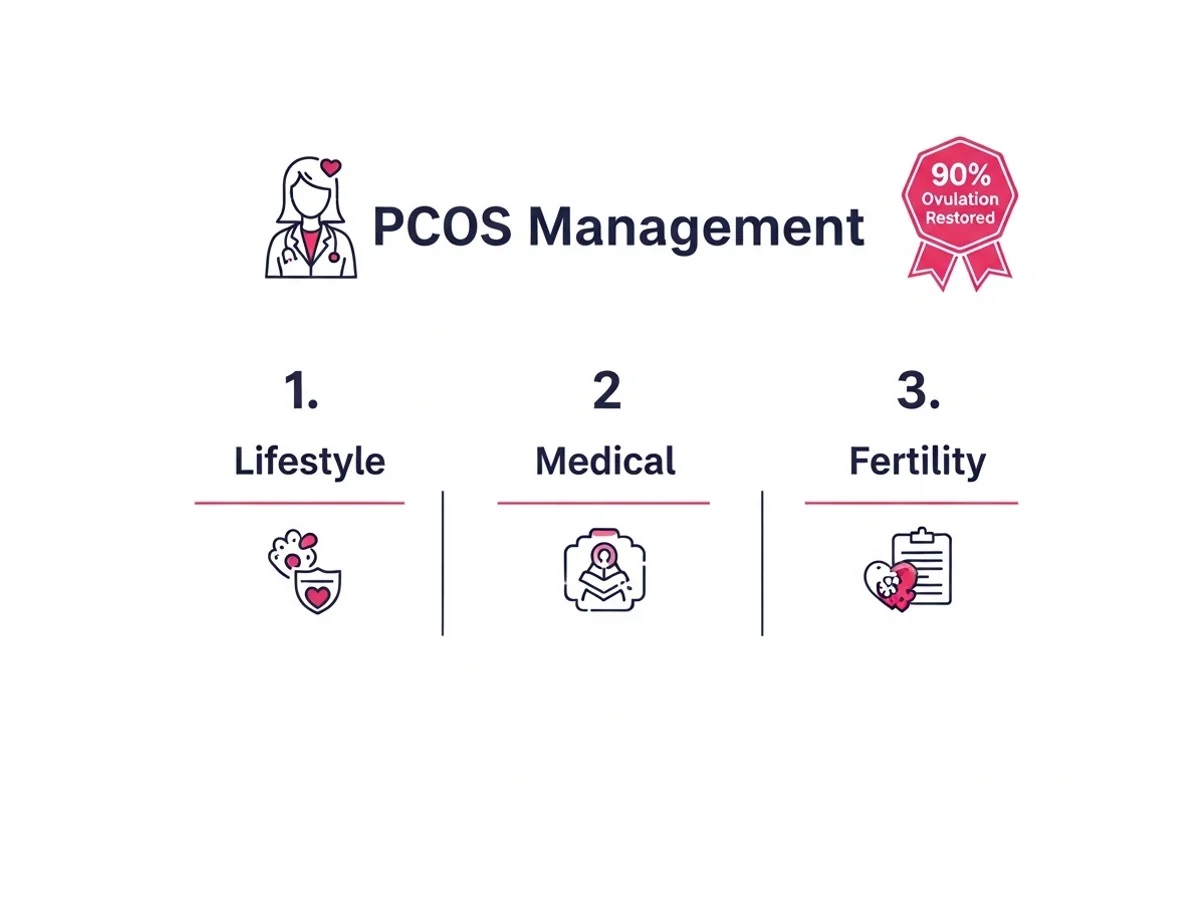
How We Treat PCOS
Lifestyle and Metabolic Optimization
Targeted dietary modifications, structured exercise plans, and weight management strategies that improve insulin sensitivity and can restore ovulation in many patients without medication.
Ovulation Induction
Medications such as letrozole or clomiphene citrate stimulate the ovaries to develop and release a mature egg, monitored with serial ultrasound to ensure a safe and effective response.
Insulin-Sensitizing Therapy
Metformin or inositol supplementation for insulin-resistant PCOS to lower insulin levels, reduce androgen production, and improve the response to ovulation induction.
Intrauterine Insemination (IUI)
When ovulation induction alone has not resulted in conception, IUI combined with controlled stimulation increases the probability of fertilization.
IVF with OHSS-Aware Protocols
For patients who do not respond to simpler treatments, IVF using carefully calibrated stimulation and, when needed, a freeze-all strategy minimizes hyperstimulation risk while optimizing embryo quality.
Laparoscopic Ovarian Drilling
A minimally invasive surgical option for select patients who are resistant to medical ovulation induction, reducing androgen-producing ovarian tissue to restore natural cycles.
Why Choose Dr. Rukkayal?
- Phenotype-specific diagnosis — treatment is matched to your particular type of PCOS, not a one-size-fits-all approach.
- Direct IVF lab expertise ensures that when assisted reproduction is needed, ovarian stimulation and embryology are managed with precision to avoid hyperstimulation.
- Integrated metabolic and reproductive care — insulin resistance, weight management, and hormonal correction are addressed alongside fertility treatment.
- International fellowship training (MRCOG UK, FRM Germany) brings globally validated treatment protocols to your care.
- Ongoing monitoring and protocol adjustment based on your body's real-time response, not fixed templates.
- Empathetic communication that helps you understand your condition and every step of your treatment plan.
- Convenient locations across Chennai — Kilpauk, Mylapore, Thiruvanmiyur, and Pallikaranai — plus visiting consultant at Apollo, Motherhood & Cloudnine hospitals.
Your Treatment Journey
Detailed Assessment
A comprehensive review of your menstrual history, symptoms, previous investigations, and lifestyle factors. Dr. Rukkayal identifies which PCOS phenotype applies to you.
Diagnostic Investigations
Targeted blood work (hormones, AMH, insulin, metabolic panel) and ultrasound to confirm the diagnosis and evaluate your current ovarian function and metabolic health.
Personalized Treatment Plan
Based on your phenotype, fertility goals, and metabolic profile, Dr. Rukkayal recommends a tailored plan — starting with the least invasive effective option.
Ovulation Monitoring
Serial ultrasound scans and blood tests track your response to treatment, with medication doses adjusted in real time to achieve safe, single-follicle ovulation when possible.
Fertility Treatment
Depending on your response and clinical needs, treatment may involve timed intercourse, IUI, or IVF — always with careful monitoring for ovarian hyperstimulation.
Pregnancy Support and Follow-Up
Once pregnant, early monitoring ensures the pregnancy is progressing well. Long-term metabolic health guidance is provided to support your overall well-being beyond conception.
Have Questions About Your Treatment?
Book a consultation with Dr. Rukkayal Fathima to understand your options and next steps.
Frequently Asked Questions
Yes. Regular periods do not guarantee ovulation. Some women with PCOS have cycles that appear regular but are anovulatory — meaning no egg is released. Ovulation tracking with ultrasound and progesterone testing can confirm whether you are actually ovulating each month.
PCOS is a chronic condition that cannot be "cured," but it can be managed very effectively. With the right combination of lifestyle changes, metabolic optimization, and medical treatment, most symptoms — including irregular ovulation — can be controlled, and fertility outcomes are excellent.
Elevated insulin levels stimulate the ovaries to produce excess androgens, which disrupt normal follicular development and ovulation. Treating insulin resistance — through diet, exercise, and sometimes medication like metformin — can restore ovulation in many women with PCOS.
Lean PCOS occurs in women with a normal BMI who still have hormonal imbalances and anovulation. Insulin-resistant PCOS is associated with higher BMI and metabolic issues. The distinction matters because treatment strategies differ — lean PCOS may respond better to ovulation induction alone, while insulin-resistant PCOS often requires metabolic intervention first.
For women with insulin-resistant PCOS, even a modest weight reduction of 5 to 10 percent of body weight can significantly improve insulin sensitivity, lower androgen levels, and restore spontaneous ovulation. However, lean PCOS patients may not benefit from weight loss and need a different approach.
Women with PCOS are at higher risk of OHSS because their ovaries tend to produce many follicles in response to stimulation. Dr. Rukkayal uses low-dose protocols, GnRH agonist triggers, and freeze-all strategies when appropriate to minimize this risk while still achieving excellent embryo yields.
Some women with mild PCOS conceive naturally after lifestyle optimization alone — particularly if their cycles become more regular with weight management and dietary changes. However, if natural conception does not occur within a reasonable timeframe, ovulation induction is a well-established and effective next step.
Typically, three to six medicated ovulation induction cycles (with or without IUI) are recommended before progressing to IVF. The exact number depends on your age, response to medication, and any additional factors. Dr. Rukkayal reassesses the plan after every cycle.
Women with PCOS have a somewhat higher risk of gestational diabetes, pregnancy-induced hypertension, and preterm delivery. Proactive monitoring and metabolic management during pregnancy significantly reduce these risks. Dr. Rukkayal provides guidance on managing PCOS-related pregnancy considerations.
Related Specialties
Female Infertility Treatment
Comprehensive evaluation and treatment for all causes of female infertility, including PCOS.
IVF Treatment
Advanced IVF with OHSS-aware protocols specifically tailored for PCOS patients.
Ovulation Induction
Monitored ovulation induction to restore regular egg release for women with anovulatory PCOS.
Gynecology Care
Comprehensive gynaecological care — menstrual disorders, fibroids, preventive screening, and women's health.
IUI Treatment
Intrauterine insemination — often the first-line fertility treatment for PCOS patients after ovulation is restored.
Related Articles
Facial Hair in Women: Causes & Treatment
Excess facial hair in women treatment options in Chennai. Learn about hirsutism causes, diagnosis, and management with Dr. Rukkayal Fathima.
9 min read
Hormonal Acne: Causes & Treatment
Understand hormonal acne in women, its causes, and effective treatment options available in Chennai. Expert insights from Dr. Rukkayal Fathima.
8 min read
PCOS Hair Loss: Regrowth Tips
PCOS hair loss frustrating you? Dr. Rukkayal in Chennai explains causes, treatments, and regrowth strategies. Book a consult!
8 min read
PCOS Treatment for Unmarried Women
PCOS treatment for unmarried women in Chennai: symptoms, lifestyle changes, and future fertility. Expert advice from Dr. Rukkayal Fathima.
8 min read
PCOS Weight Loss: Tips & Treatment
Struggling to lose weight with PCOS? Dr. Rukkayal in Chennai explains why and offers effective, evidence-based solutions.
9 min read
PCOD vs PCOS: Key Differences & Treatment
PCOD vs PCOS — what's the real difference? Dr. Rukkayal explains symptoms, diagnosis criteria, and treatment options for women in Chennai.
10 min read
Masturbation & PCOS: Is There a Link?
Debunking myths about masturbation and PCOS in Chennai. Get expert insights and personalised PCOS treatment plans.
8 min read
Hormonal Imbalance & Infertility
Understand how hormonal imbalances affect fertility in women in Chennai. Learn about symptoms, diagnosis, and treatment options.
12 min read
Ready to Get Started?
Book a consultation with Dr. Rukkayal Fathima about your treatment options
Book AppointmentBook Consultation
Consultation Booked!
Thank you for reaching out. Our team will contact you shortly to confirm your appointment.
Need urgent help? Call us